How the LinkedIn feed ranks video in 2026
LinkedIn does not rank video by views. It runs a short dwell test, decides who you are for, and then mostly stops. Understanding the sequence changes what you post.
On this page
Most advice about the LinkedIn algorithm is written as if there is one score and you are trying to raise it. There is not. There is a sequence of decisions, each with its own test, and a post that passes the first and fails the second behaves completely differently from a post that fails the first outright.
We publish somewhere north of four hundred client videos a month and read the analytics on all of them. What follows is the sequence as we observe it, not as LinkedIn documents it, because LinkedIn documents very little.
Stage one: the dwell test
When you post, LinkedIn shows the video to a small slice of your network. Small, usually a few percent. What it measures in that window is not likes. It is dwell time: how long the post occupied the viewport, and whether people stopped scrolling.
This is why the first two seconds matter more than everything else combined. Not because of some engagement-bait theory, but because the test is literally "did the scroll stop", and a video that opens on a title card or a logo gives the scroll no reason to stop.
Three things reliably fail this stage:
- An intro. Any intro. The branded sting, the "hey everyone", the slow zoom into a face. All of it is spent inside the window being measured.
- No captions. The overwhelming majority of feed video is watched muted. Silent video with no burned-in text is a black box, and viewers scroll past black boxes.
- Landscape framing on mobile. A 16:9 video in a vertical feed occupies roughly a third of the screen height that a square or 4:5 crop does. Less viewport, less dwell, mechanically.
What passes it
A face already talking on frame one, a caption already on screen, and a claim in the first sentence that some part of the audience disagrees with. That is close to the whole recipe. Everything else is refinement.
Stage two: deciding who you are for
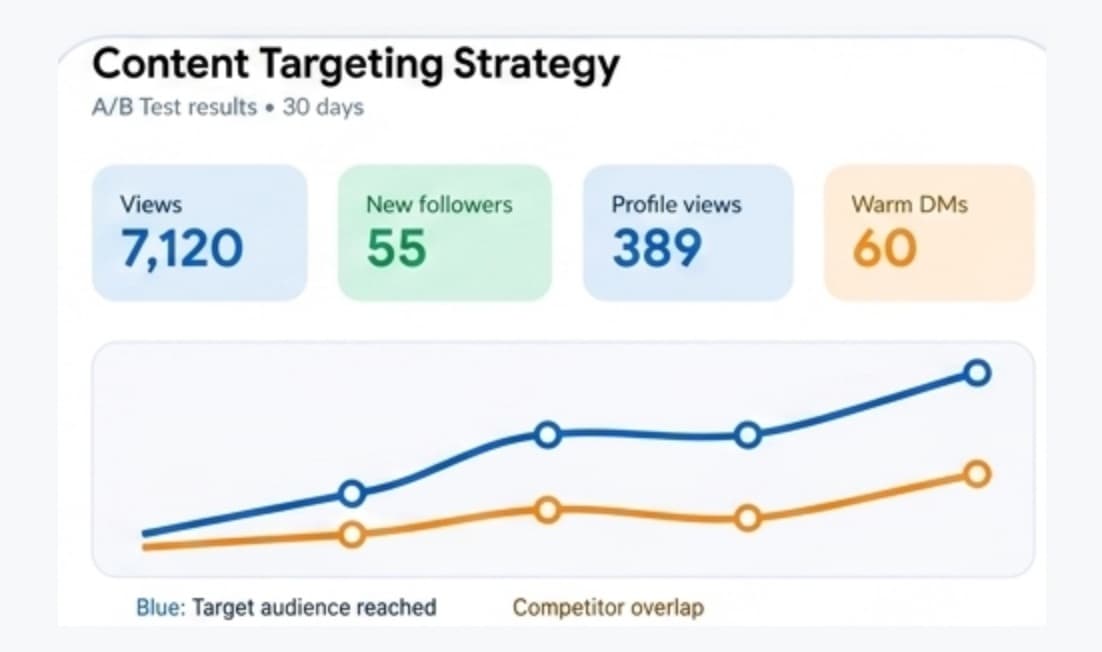
If the dwell test passes, the post expands, but not evenly. LinkedIn is looking at who engaged, not how many, and it uses that to decide which further slices of the network to show it to.
This is the stage where most B2B teams accidentally sabotage themselves. Asking colleagues to like the post teaches the feed that your content is for people who work at your company. The expansion then goes sideways into adjacent employees and recruiters rather than outward into buyers, and the post ends with a healthy-looking view count and no relevance at all.
A thousand views from the wrong graph is not a smaller version of success. It is a signal you will have to spend the next several posts undoing.
The practical rule: if you are going to seed engagement, seed it from people who look like the buyer. Five comments from operators in your category are worth more than fifty from your own team, and the difference is visible in the next post's distribution rather than this one's.
Stage three: the second wave
Roughly four to twenty-four hours in, a post that survived the first two stages gets a second push. What determines whether this happens is the ratio of meaningful engagement to impressions: comments with substance, shares with commentary, and, disproportionately, saves.
Reactions barely register at this stage. A post with two hundred reactions and no comments almost never gets the second wave. A post with thirty reactions and eleven real comments usually does.
| Signal | Stage it affects | Rough weight | What it costs you to get it |
|---|---|---|---|
| Dwell / scroll-stop | One | Decisive | Ruthless first two seconds |
| Watch-through past 30s | One and two | High | One idea per video, no padding |
| Comment with substance | Three | High | A stated position worth arguing with |
| Save | Three | High, under-reported | Something reusable, a number or a checklist |
| Share with commentary | Three | Moderate | Rare. Do not plan around it. |
| Reaction | Two only | Low | Nearly free, and worth about that |
| External link in post body | All, negatively | Penalised | Move it to the first comment |
The link question, settled
Yes, an outbound link in the post body suppresses reach. No, putting it in the first comment is not a clever loophole the platform has closed. It still works, because the ranking pass reads the post body and the comment is a separate object.
But the more useful framing is that most B2B video should not carry a link at all. The video's job is to be seen by the right person. The link's job is to be in the outreach message you send that person a week later, when they already recognise your face. Stapling a CTA to every post trades the first job for a very small amount of the second.
What does not matter as much as you think
- Posting time. It matters at the margin and it is the single most over-optimised variable in the category. The dwell test runs whenever you post; a good video at 4pm beats a weak one at the mythical optimal hour.
- Hashtags. Their discovery value collapsed years ago. Two or three do no harm. Eleven look like spam to humans, which is the actual cost.
- Post length. Below roughly the "see more" fold, length is neutral. The fold itself matters, because the first line is doing the same job as the first two seconds of the video.
- Video length. Within reason. A ninety-second video with a strong open outperforms a thirty-second one with a weak one. Retention percentage is a rate, not a duration.
How we instrument it
Native LinkedIn analytics will tell you impressions, members reached, and a watch-time figure that is not directly comparable between post types. It will not tell you the thing you need, which is whether the people who saw the video behave differently when you contact them.
So we join it manually. Every video is tagged to the outreach cohort that runs alongside it, and the number we actually report is the difference in positive reply rate between contacts who were served the videos and contacts who were not. It moves later than view count and it is the only number that has ever predicted pipeline.
If you are building this yourself, that join is the part worth your engineering time. The rest of it is a spreadsheet.
For the strategic case underneath all of this, meaning why the video is worth making before you worry about how it is ranked, see why B2B buyers trust a face over a feature list.
More on distribution
Founder-led video: why B2B buyers trust a face over a feature list
Feature pages answer what your product does. Your buyer is deciding something else entirely. They are deciding whether the people behind it are worth a meeting.
Ready to put this on your own feed?
One intake call becomes a month of video, scripts and outreach. The first video is free, and there is nothing to install.